What is a roll container?

A roll container is a mobile transport and storage container on casters. It is used to easily move goods or materials within warehouses, supermarkets, drugstores, and specialty stores, as well as in production facilities or during the transport of goods. The goal is the simple, efficient transport of goods or a wide variety of products.

Typical features:

  • 4 casters, often two swivel casters and two fixed casters.
  • A metal or plastic base platform; rarely made of wood.
  • Mesh side walls to secure the load and keep it visible.
  • Sometimes available with 2, 3, or 4 side walls, as well as a door or lid.


Areas of application:

The applications and possibilities are numerous; upon closer inspection, there are few areas where a roll container might not be useful. Possible applications include, for example:

Depending on the model, roll containers typically carry between 300 and 800 kg; special models can carry significantly more.


The term “roll container” is sometimes used interchangeably with “roll cart.” In everyday language, the two terms usually refer to the same item: a transport cart on casters with one or more mesh sides. In some industries, “roll container” can also refer to office furniture or trash bins on casters—the meaning is then determined by the context.
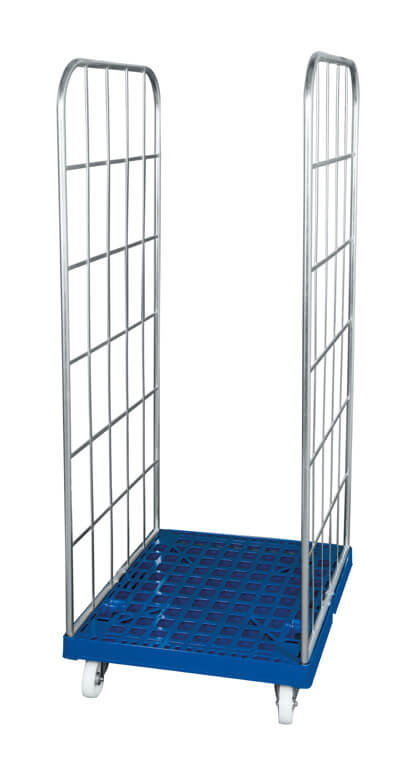
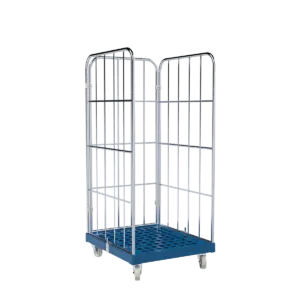
Double-sided roll container from FEIL rolltainer

Layout & number of walls

Depending on the type of stock security required, you can choose between 2-sided (quick access from both sides), 3-sided or fully enclosed 4-sided models (optionally lockable to protect against theft).

Load capacity and stability

The maximum load capacity (which is usually between 400 kg and 800 kg as standard) must be suitable for the type of goods being transported. The construction of the floor (plastic floor, wooden panel or coated steel) also plays a crucial role in determining its durability.

Wheel components and tyres

The choice of castors (polypropylene, polyamide or solid elastic rubber) determines the rolling resistance, noise levels and suitability for different floor surfaces (e.g. quiet rubber tyres for retail spaces versus hard polyamide for smooth industrial floors).

Space-saving

For reverse logistics, nestable (stackable) or dismantlable/foldable designs are essential for saving valuable floor space during return transport by lorry or in the warehouse.

Roll Containers / rolltainer®

Rolltainer 1450 KU Blue Roll Container, 724 x 815 mm, 3-sided, Cr 3Our roll containers, orrolltainer®, are among the most trusted means of transport for warehousing and logistics. They enable the safe transport of goods, boxes, containers, or production materials and ensure efficient processes throughout the entire supply chain.
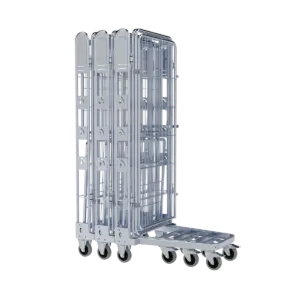
Various models are available depending on the application:

  • 2-sided roll containers
  • 3-sided roll containers
  • 4-sided roll containers
  • Rolling containers with shelves
  • Roll containers with customizable features

Thanks to their robust construction, these systems are suitable for both daily use in logistics centers and for in-store transport in retail.

Discover rolltainer

Nestable Transport Solutions / nestainer®

Nestable Roll Containers - nestainer® 1630, 4-sided, steel bottom (N47308451C1ZC46)Nestable roll containers are portable mesh carts on casters whose base and sidewall construction is designed so that, when empty, they can be pushed into one another (“nested”) like shopping carts. This significantly reduces the space required for empty transport. After unloading, the containers can be nested inside one another, thereby saving valuable storage and transport space. Companies benefit from lower transportation costs and more efficient use of space.

  • Maximum space savings: When empty, nested containers save up to 75–80% of floor space in the warehouse or on the truck bed.
  • Reduced return transport costs: Empty containers can be bundled extremely compactly during return transport (empty container logistics), saving cargo space and reducing transport costs.
  • No disassembly required: Unlike collapsible roll containers (plug-in systems), no individual parts need to be removed or stored separately.
  • Quick handling: Folding and nesting takes only a few seconds per container.
  • Efficient flow of goods: They are ideal for closed-loop logistics cycles, such as between a central warehouse and retail locations.


Why FEIL?

For many years, FEIL has been synonymous with high-quality solutions in the fields of warehousing, transportation, and industrial engineering.

Many companies across a wide range of industries rely on our experience, technical expertise, and practical advice. We help our customers find the right roll container for their specific needs—from standard solutions to custom-made designs.
We are also a manufacturer, an innovation leader, and a provider of logistics, transportation, and customized solutions.

Your benefits with FEIL:

  • Wide selection of high-quality roll containers
  • Expert technical advice
  • Customized solutions for specific requirements
  • High product quality and durable designs
  • Reliable delivery and personalized support

Our goal is to help companies streamline their processes and reduce costs in the long term through well-designed transport and storage solutions.

Frequently asked questions (FAQ)

The optimal size depends on the goods being transported, the available storage space, and the transport routes. Standard dimensions allow for efficient use of storage and loading areas, as well as optimal utilization of truck capacity. For special requirements, roll containers can also be manufactured in custom sizes.

Double-sided roll containerA roll container is a mobile transport cart on casters used for the internal transport and storage of goods, boxes, containers, tools, or laundry. Depending on the model, it features two, three, or four side walls made of mesh or solid panels and can be flexibly adapted to various transport tasks.

High-quality, galvanized, or specially coated roll containers with easy-to-clean surfaces are particularly well-suited for use in the food industry. Depending on the application, additional hygiene requirements and industry-specific regulations must also be taken into account. Sturdy construction and durable materials ensure the safe transport of food.

The terms are often used interchangeably, but they differ depending on the industry and application. A roll container typically consists of a base plate with mesh sides and is used to transport large quantities of goods in warehousing and logistics. A rolling container, on the other hand, often refers to a closed container or a mobile cabinet, for example in office or healthcare settings. In retail and logistics, the term “roll container” is the more common designation. Depending on the region and application, there are also many other synonyms, such as mesh cart, transport cart, rolling cart, transport roll container, transport container, “Rolli,” and many more….

Yes. Many companies need solutions that are precisely tailored to their products, processes, or warehouse space. Custom roll containers, for example, can be adapted in terms of dimensions, load capacity, casters, shelves, lids, mesh design, or surface coating. This results in customized transport solutions that offer optimal cost-effectiveness.

This is where our many years of expertise really shine, allowing us to offer custom-made transport solutions—all from a single source.

When empty, nestable roll containers can be stacked inside one another to save space. This significantly reduces the amount of storage and transport space required. Companies benefit from lower return shipping costs, better utilization of truck capacity, and more efficient space management in the warehouse. Nestable roll containers are therefore among the most cost-effective solutions, particularly in retail, the food industry, and among logistics service providers. You can find nestable roll containers from FEIL on the market under the brand name nestainer®

A “rolltainer” is a trademarked term used by FEIL for roll containers and has become well-established in the market. In practice, there is no real difference between a roll container and a Rolltainer.
Both terms refer to exactly the same logistics solution: a roll pallet with two, three, or four mesh side walls, which is used primarily in retail (e.g., in supermarkets for stocking shelves) and in intralogistics.

Rolltainer:
A portmanteau of “Roll” (to roll) and “Container” (container). This term is primarily used in practice, in English-speaking countries (“Rolltainer” / “Roll Container”), and by some manufacturers as a marketing or brand name.

On uneven or rough floors, you should use casters that effectively absorb shocks and vibrations. Elastic casters and high-quality solid rubber casters offer excellent shock-absorbing properties and ensure a smooth ride. For outdoor use or particularly challenging surfaces, larger casters may also be a good choice, as they can overcome obstacles more easily and reduce rolling resistance. The caster’s hardness is also a key factor in determining the noise level when rolling,