Movement begins on wheels. But which ones are the right ones?
Factors such as load capacity, environment, substrate, and price determine the optimal solution. The following overview will help you make the right choice.

Movement begins on wheels. But which ones are the right ones?
Factors such as load capacity, environment, substrate, and price determine the optimal solution. The following overview will help you make the right choice.
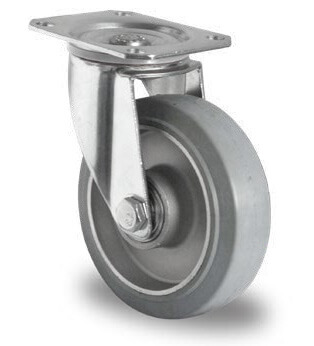
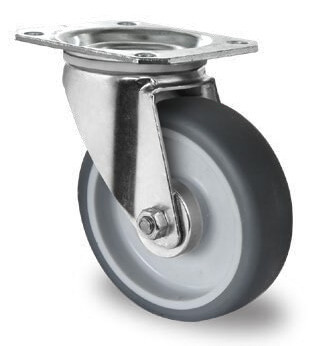

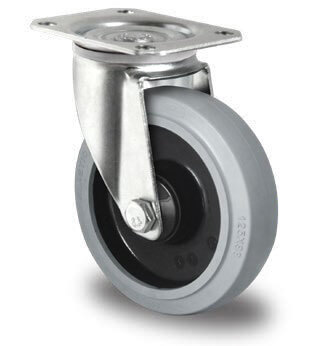
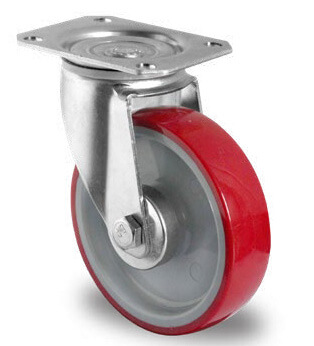
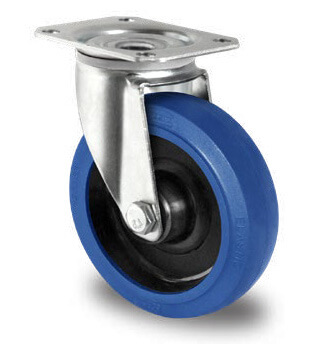
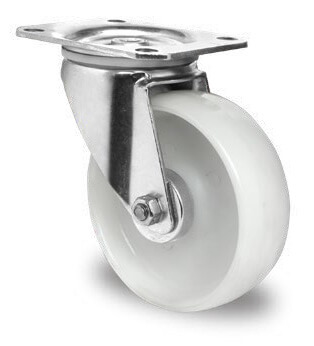
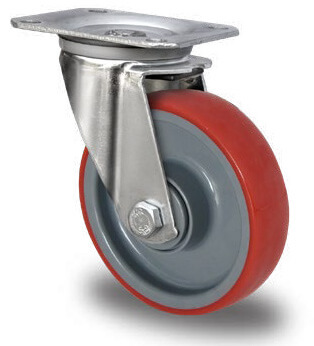

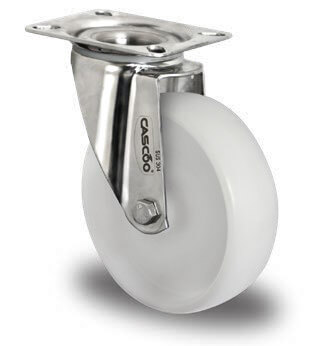
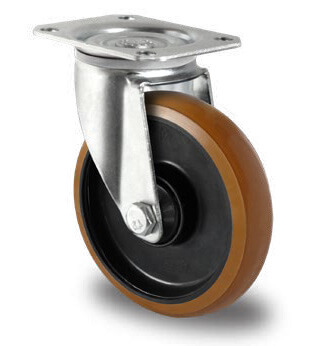
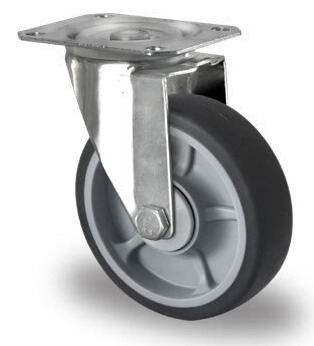
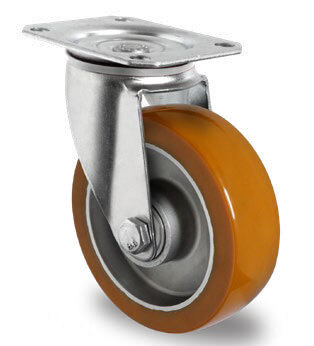
P0P0 & N0N0 – the classics
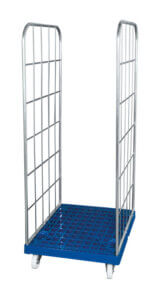
The classic casters for every roll container are the ø 108 mm casters made of polypropylene (PP) or polyamide (PA). Our PP castors from the P0P0 series offer excellent value for money and are the ideal solution for the daily transport of your goods. If the environmental requirements are more demanding, then our PA castors from the N0N0 series are the right choice. Heavy loads and both high and low temperatures can be handled ideally with our polyamide (PA) castors.
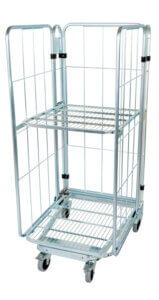 R4F1 & R4E2 – the silent ones
Of course, these casters are not completely silent, but our elastic casters from the R4F1/R4E2 series impress with their whisper-quiet running thanks to their particularly soft running surfaces. The high proportion of natural rubber ensures low starting resistance and a durable material even under high loads.
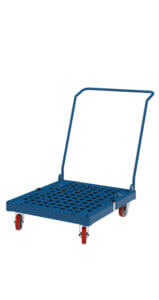 N2U6 & M6N2 – the robust casters
Our N2U6 and M6N2 series casters are particularly robust and durable. The N2U6 series features thermoplastic polyurethane (TPU) on a polyamide rim. TPU is particularly durable and resistant to a wide range of acids, oils, and greases. The M6N2 series combines the advantages of the PA series with slight noise reduction and the possibility of lateral displacement.
P2W2 & P2G2 – the lightweight casters
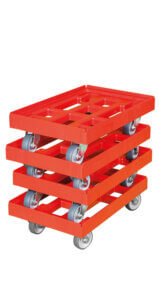 If the goods you need to transport are not particularly heavy and you still want to reduce noise levels, our P2W2 and P2G2 series TPE casters are the perfect choice. These casters combine design with functionality. They are mainly used indoors, where their elastic surface ensures smooth internal transport and attractive presentation of your goods.
AAE2 & AAU5 – the strong rollers
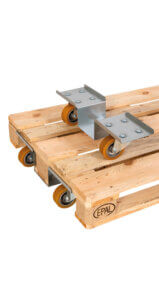 Special situations call for special measures! If you haven't found what you're looking for yet, you're sure to find it among our strong alternatives, the AAE2 and AAU5 series with aluminum rims. When using four casters, goods weighing up to 900 kg can be transported. Both series, the elastic and the cast polyurethane, offer different advantages.
See for yourself!
N4B5 & AAB5 – the agile roles
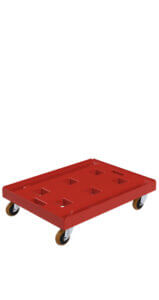 The physical strain on employees during the transport and processing of goods is playing an increasingly important role in the assessment of working environments and ergonomics today. For this reason, we have developed two wheels (series N4B5 and series AAB5) that impress with their enormous flexibility and low resistance despite high loads. The wheel's convex and thin contact surface minimizes friction and resistance, thus contributing to easier handling of goods.
N0N0 & N2U6 – the stainless rollers
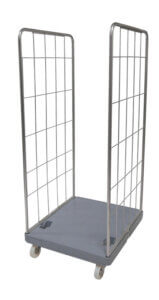 Some business areas require the use of rustproof materials such as plastic or stainless steel. We also have suitable solutions for these cases. The housings of our rustproof stainless steel casters in the N0N0 & N2U6 series are made of V2A (AISI 304) and are therefore corrosion-resistant, weatherproof, durable, conductive, temperature-resistant, and also very hygienic.
Here you will find a compact summary and guide in PDF format—perfect for initial orientation.
through high-quality cores
Floor-friendly and quiet running surfaces thanks to elastic rubber wheels
Designed for tough industrial use
The housings (forks) are usually zinc-chromated.
Less wear and tear, as the bearings are well sealed
A distinction is made between:
The total lock is the most common type.
Important: A lock prevents the bike from rolling away—it is not a substitute for brakes.
Function according to operating conditions
Combination of 2 fixed casters + 1 swivel caster + 1 swivel caster with total lock
Combination of 2 fixed casters + 2 swivel casters with total lock
The operator is responsible for ensuring that the system is used in accordance with the law.
The choice of material determines performance and ease of use. Depending on the design, casters differ in hardness, weight, noise level, and load capacity.
Each material has different properties and therefore different advantages and disadvantages. Material can be soft or hard, loud or quiet, solid or light, and much more.
Still unsure?
Contact us—we will be happy to advise youand develop customized solutions if required.
Both variants have their advantages. Two swivel casters and two fixed casters are ideal for longer distances. The fixed casters ensure stable straight-line running and reduce the need for constant correction of the direction of travel. Four swivel casters offer maximum maneuverability. Perfect for narrow aisles and frequent maneuvering—similar to a shopping cart.
Rule of thumb:
Calculating the correct load capacity
For casters with four rollers, it must be taken into account that uneven surfaces may cause one roller to lose contact with the floor at times. For this reason, the total load capacity is always calculated based on three of the four rollers. All load capacities specified comply with DIN EN 12532 and apply per roller (dynamic load).
Rule of thumb:
Let's find the right solution together - we look forward to hearing from you.